
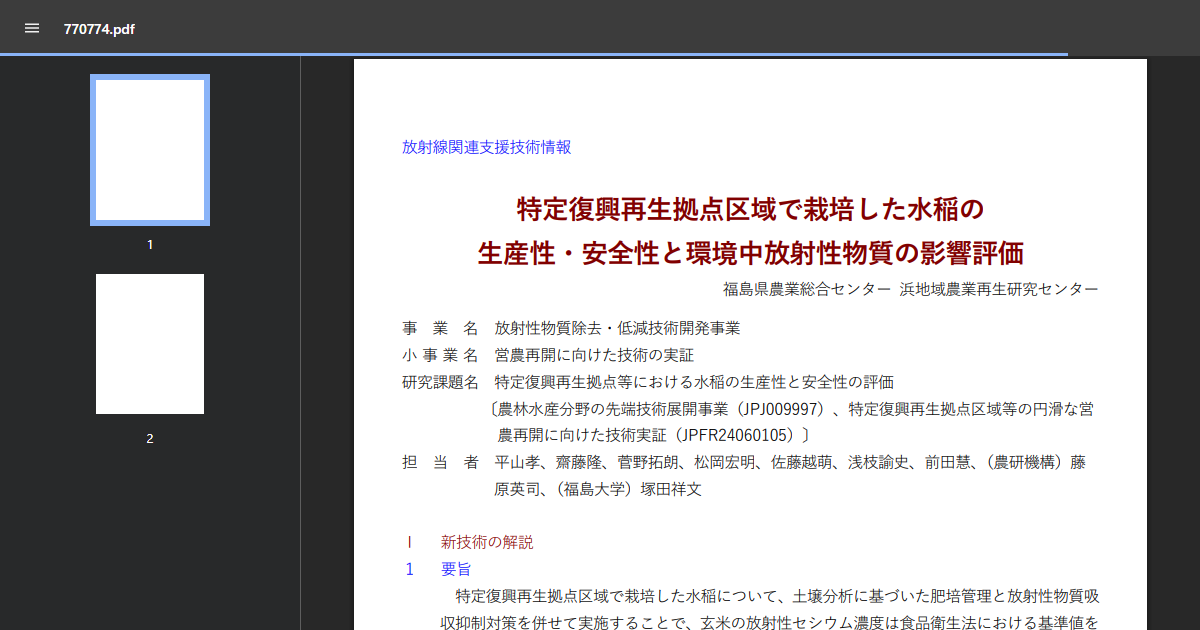
Image: Fukushima Prefecture website (photographed November 24, 2026)
Summary: The Fukushima Agricultural Technology Centre has released the results of paddy rice cultivation trials conducted in four municipalities within the Specified Reconstruction and Revitalization Base Areas. With fertilization based on soil analysis and measures to suppress uptake, cesium concentrations in brown rice were below the standard limit, and yields largely reached pre-disaster levels.
Key points
- The trials were carried out in four municipalities within the Specified Reconstruction and Revitalization Base Areas (Okuma, Futaba, Katsurao and Namie). Fertilizer was managed according to the Fukushima Prefecture fertilization standards based on soil analysis, and the target level of exchangeable potassium in the soil was secured. As a result, radioactive cesium in brown rice was far below the standard limit, and stayed under 25 Bq/kg for every variety and year in the table.
- Yields largely reached pre-disaster levels. For example, Koshihikari in Okuma (2021–25) yielded 523 kg per 10 a, and Ten no Tsubu in Futaba (2021 and 2024–25) yielded 697 kg. The average yields over the ten years before the disaster were 488 kg and 502 kg respectively.
- The effects of radioactive fallout from the atmosphere and of irrigation water were judged to be extremely slight. Cesium in brown rice estimated to come from fallout was under 5 Bq/kg, and that from irrigation water was under 1 Bq/kg in every year. For fields growing paddy rice for the first time since the nuclear accident, securing the target level of exchangeable potassium (25 mg K2O/100g dry soil) was noted as a key point.
Why we are paying attention to this news
This material lets us confirm with numbers that rice farming has resumed in areas where evacuation orders have been lifted. Yields and brown rice measurements are shown by year and by variety, offering a clue to how local agriculture stands today.
For those visiting Fukushima, it can serve as a reference when learning about local food and farming. It is worth keeping in mind, as background, the accumulated effort of farmers who examined their soil and carried out countermeasures step by step.
Staff comments

青葉 港Investigation & Research
“What caught my eye was that the results from the four municipalities are laid out in tables by variety and by year, and that cesium in brown rice is shown as below 25 Bq/kg in every case.”

広瀬 ソフィーWriting & Translation
“Looking at the table Mr. Aoba mentions, it conveys concretely that rice is being grown in Okuma and Futaba. I think readers will feel the resumption of daily life there more closely.”

定禅寺 真子Proofreading & Verification
“I checked this following the two of you. The trial period is fiscal 2025 (Reiwa 7), yields are compared against the average of the ten years before the disaster, and for fields newly starting cultivation, securing the potassium target of 25 mg K2O/100g dry soil is the key point.”
Editor-in-Chief’s comment

伊達 蓮Editor-in-Chief
The figures are based on materials from the Hama Regional Agricultural Revitalization Research Center of the Fukushima Agricultural Technology Centre. For conditions by variety and measurement details, please check the table on the source page.
Source: Fukushima Prefectureホームページ「特定復興再生拠点区域で栽培した水稲の 生産性・安全性と環境中放射性物質の影響評価」 (Fukushima Prefecture website, “Productivity and safety of paddy rice grown in the Specified Reconstruction and Revitalization Base Areas, and evaluation of the impact of radioactive materials in the environment”) (2026-11-18)
The Tohokuru editorial team summarized and explained this article based on the source. The featured image is a screenshot of the source page. Please see the source article for details. The staff comments are by the dedicated staff of the Public Action Office.